Ok now we all know that backing iPhone up is important. However, what if I want to view what I’ve saved before restoring or need to look through the files to select which backup to recover?
The problem is that native Apple tools can’t let you view your iPhone backup files. You of course can find backup files on your PC, but they are encrypted and can’t be opened on PC. Happily, there is a free solution
Let’s start with the type of backups that Apple offers you. You can choose between two options:
- iTunes backup (local backup stored on PC)
- iCloud backup (backup is saved in your iCloud storage)
These two types of backups aren’t the same: the store different data. You can find more information about what is included in iPhone backups here.
View iPhone backups on PC
You can manually find an iTunes (or any third-party software) backup files in your windows Explorer. The path is: C:\Users\Your username\AppData\Roaming\Apple Computer\MobileSync\Backup\. To see the iPhone backup location for all kinds of Windows see this guide.
To view what’s included in your iPhone backup, have no doubt and use CopyTrans Backup Extractor – it is compatible with all kinds of iOS and iCloud backups. With its convenient browsing feature, you can easily view and access all your iPhone and iCloud data. Here is what you get with CopyTrans Backup Extractor:

✔️ find all the backups automatically;
✔️ save all the backup data on your PC
✔️ compatible with different backups: iCloud, iTunes, CopyTrans Shelbee, or other programs;
Here is how to browse your iPhone backups:
-
Download and install CopyTrans Backup Extractor.
-
Launch the program and it will start searching for backups on your PC.
-
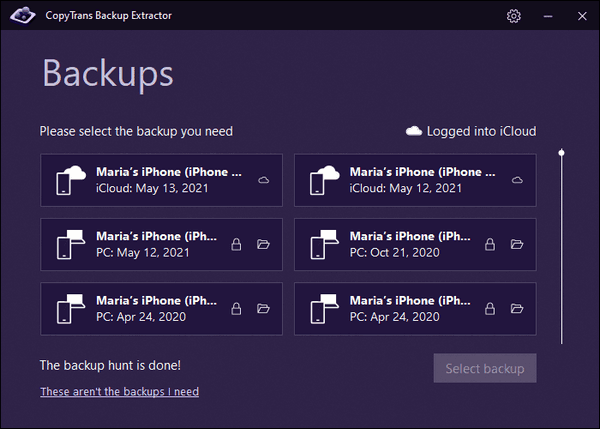
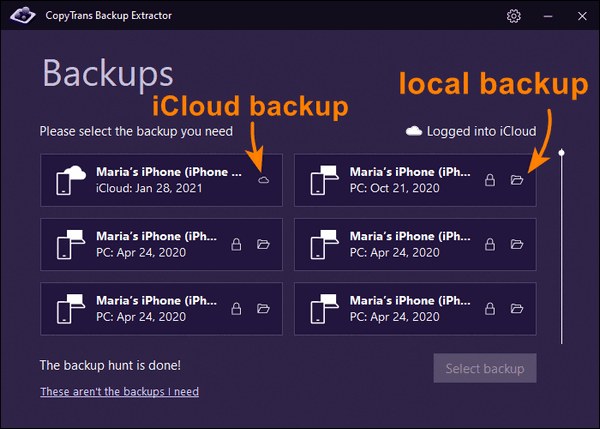
Now you will see all the backups available on your PC.
-
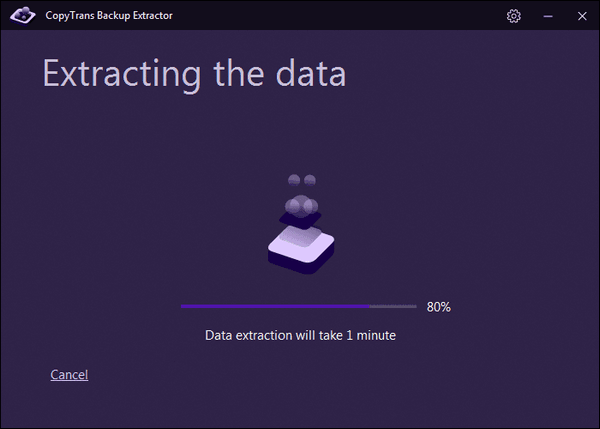
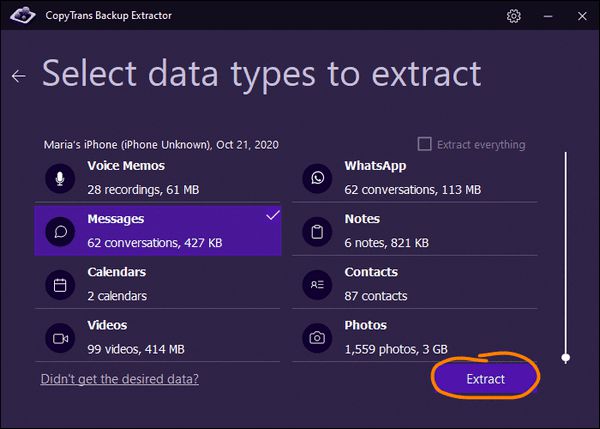
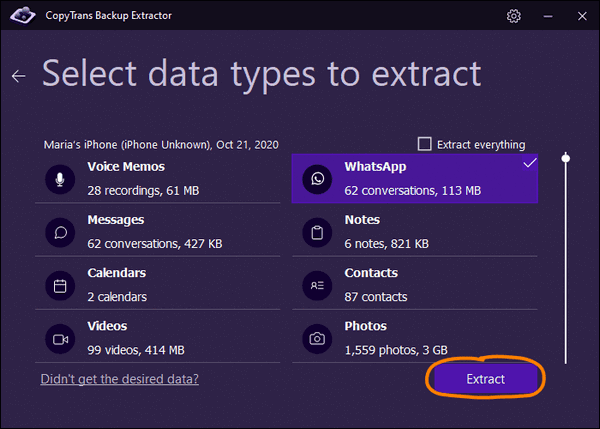
To view iPhone backup files, click on the backup you are interested in, then choose the exact data you need and click on Extract.
-
That is how to view iPhone backup files on Windows 10 or 11.
View iCloud backup files
iCloud backups are a convenient solution if you don’t trust local backups or want to save disk space. In this case, the iPhone backup is stored online, and you’d need a stable internet connection to download it back to your device. However, please remember that restore of iCloud backup would require you to erase your iPhone beforehand. In this situation, it is better to be sure that the backup is the right one. See below how to connect CopyTrans Backup Extractor to iCloud and browse iCloud backups.
-
Download and install CopyTrans Backup Extractor.
-
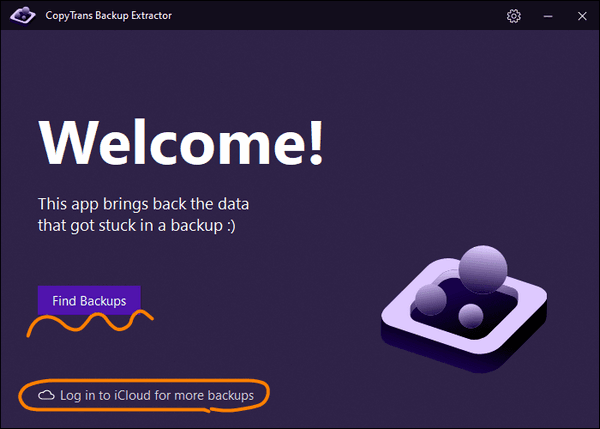
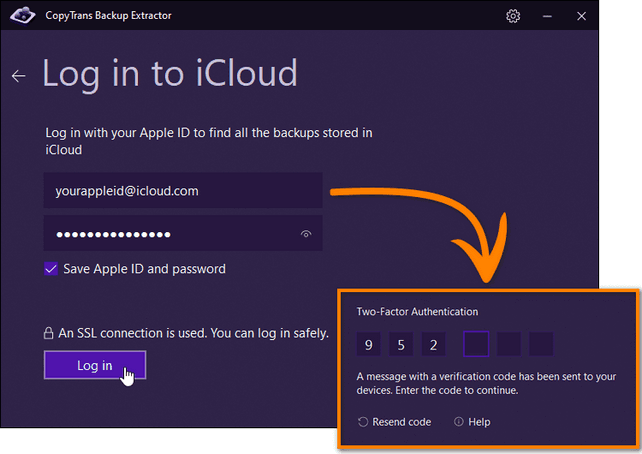
Launch the program and choose the option “Login to iCloud for more backups”.
-
Log in to your iCloud account.
-
Now you will see the local and iCloud backups.
-
Now open the backup you need and choose the data to view and save on your PC. Click on “Extract” and choose the folder.
-
That’s it! With a few clicks and you can view iCloud backup files.
Download CopyTrans Backup Extractor
iPhone backup viewer
FAQ
Is it possible to view an iPhone backup without restoring it?
Of course. That’s the whole point of tools like CopyTrans Backup Extractor. Instead of completely restoring your iPhone (which would completely erase your current data), you can view the backup and extract just the essentials — like photos, contacts, messages, or WhatsApp chats — directly to your computer.
What does an iPhone backup actually contain?
More than you think. An iPhone backup can include messages, call history, contacts, photos, videos, app data, settings, voice memos, and even Safari bookmarks. But depending on whether the backup was made to iTunes or iCloud, and whether encryption was enabled, the contents may differ slightly.
Can you open iPhone backup files in File Explorer?
Technically, yes, but… good luck understanding them. iTunes backup files are stored locally on your computer in a hidden folder, but their formats are unreadable. Most of them look like random strings with no extensions. You’ll need a backup viewer like CopyTrans Backup Extractor to make the data usable.
Can I extract WhatsApp from an old iPhone backup?
Yes, even if the app is no longer installed on your iPhone. If the backup contains WhatsApp data, you can extract your chats and attachments using a backup viewer. This is especially useful if you’ve deleted the app but don’t want to lose your memories.
Why can’t I see my iCloud backup on my computer?
Because Apple hides it well. iCloud backups are stored in the cloud, not locally on your computer, and Apple doesn’t offer a built-in way to view or extract them. That’s where CopyTrans Backup Extractor comes in: It securely connects to your iCloud account and shows you exactly which backups are there.
Can I access an encrypted iPhone backup without a password?
No, not even Apple can. Encryption is designed to protect your data, so if you forget the password to your backup, you’re completely safe. But if you know the password, CopyTrans Backup Extractor can easily open and extract data from encrypted backups.
What if I only need one photo from a backup – do I need to extract everything?
Not at all. With CopyTrans, you can browse your backup and manually select exactly what you need. Whether it’s a single photo, a few messages, or an entire contacts folder – you control what gets extracted.
Final Thoughts
Let’s be honest: when I first tried to look into my iPhone backup, it felt like I’d opened a vault full of locked boxes. The files were there, sure, but they were scattered across encrypted folders with names that looked like code. Nothing readable. Nothing useful. I just wanted to pull out a few photos and maybe check old messages, but Apple doesn’t make it that easy.
That’s when I tried CopyTrans Backup Extractor, and it changed my life completely. No more full restores. No more hoping that I won’t lose my current data just to see what’s in an old backup. Instead, I saw everything: photos, messages, contacts, even WhatsApp chats — all neatly laid out, ready to be retrieved with just a few clicks.
And the best part? I didn’t have to be a tech expert. The tool does all the hard work, and I quickly get exactly what I need. So if you’re stuck with a mysterious iTunes backup and wondering what’s actually in it, or want to take a peek at your iCloud backup without spending hours restoring it, don’t waste time digging through system folders. Try CopyTrans Backup Extractor. You might be surprised by what you find in your backup. I certainly was.
